Cloning
The purpose of cloning is to create a DNA molecule that can be replicated and propagated, usually in a host organism like E. coli. Here, we consider the specific task of assembling a new plasmid and subsequently transforming (inserting) it into E. coli.
Preparation:
- Prepare a linearized DNA backbone. [see following section]
- Prepare linear DNA fragments that should be inserted in the required concentration. [see following section]
Input:
- Linearized DNA backbone (e.g., in PCR tube)
- Linear DNA fragments (e.g., in PCR tubes)
Output:
- E. coli with the new plasmid (e.g., as a liquid culture)
Steps:
- Gibson assembly: Construction of the new plasmid from the plasmid backbone and the DNA fragments. [see following section]
- Bacterial transformation: Insertion of the new plasmid into competent E. coli. [addgene protocol]
Preparation Step 1: Linearize DNA Backbone
Steps
- E. coli with the backbone plasmid (e.g., as a bacterial agar stab). This is often what you receive from a lab or addgene.
- Liquid bacterial culture: Prepare a culture of E. coli with the backbone. [addgene video]
- Plasmid extraction: Extract the backbone plasmid from the E. coli. [NEB protocol] and [NEB video]
- Linearize the backbone by one of the two techniques:
- Restriction Digestion of Backbone
- Linearize plasmid backbone with restriction enzyme(s). Ideally this is 1 enzyme that breaks the vector at 1 position. You can also use 2 enzymes to cut out a linear fragment.
- Digest for 1-2 hours at appropriate temperature
- Critical: Dephosphorylate vector with CIP or rSAP to prevent self-ligation
- Purification: Sometimes gel extraction is necessary to separate the linear backbone from the remaining parts
- PCR Amplification of Backbone
- Design forward and backward primers. Typically 60 bp long with 30 bp overhangs homologous to adjacent fragments.
- Perform high-fidelity PCR
- Restriction Digestion of Backbone
⚠️ What to Care About
Overlap Design:
- Make sure that your linear backbone already has the overhangs on both ends required in the next step.
- 15-20 bp minimum (shorter overlaps reduce efficiency)
- 40 bp maximum (longer can cause mispriming)
- Avoid strong secondary structures in overlap regions
- Keep GC content between 40-60% in overlaps
Fragment Quality:
- Use high-fidelity polymerase
- Verify correct product size on gel
🔍 How to Check if This Step Failed
During the step:
- Run PCR products on agarose gel (1-2%)
- Single bright band = good
- Multiple bands = non-specific amplification
- No band = PCR failed
- Smear = degradation or primer dimers
- Quantify DNA quality and concentration using a spectrometer (NanoDrop, Qubit, etc.)
Downstream indicators (if you didn't catch problems early):
- Few or no colonies after transformation → insufficient DNA or wrong fragments
- Incorrect colony PCR results → wrong product was amplified
- High background (self-ligated vector) → vector not properly dephosphorylated
Preparation Step 2: Prepare Linear Fragments
Steps
- Obtain linear fragments by one of the following:
- There are companies where you can order DNA fragments. When ordering pay attention to:
- You can often choose the amount (e.g., 4 nmol), the medium (tubes, plates), and for tubes the concentration (e.g., 100 $\mu$ M) ready for the lab ("formulation"). If you choose the latter, you do not need to dilute them yourself.
- This is available under certain constraints like GC content, repetitions, and length.
- Alternatively, if you already have a plasmid with the wanted sequence on it, you can use PCR to extract it (see backbone).
- Design forward and backward primers. Typically 60 bp long with 30 bp overhangs homologous to adjacent fragments so that they are ready for the Gibson assembly.
- Perform high-fidelity PCR
- There are companies where you can order DNA fragments. When ordering pay attention to:
⚠️ What to Care About
Overlap Design:
- 15-20 bp minimum (shorter overlaps reduce efficiency)
- 40 bp maximum (longer can cause mispriming)
- Avoid strong secondary structures in overlap regions
- Keep GC content between 40-60% in overlaps
Fragment Quality:
- Use high-fidelity polymerase
- Verify correct product size on gel
- If you are worried about having the original plasmid in the PCR mix:
- Don't use too high initial amounts of the plasmid in PCR. PCR does exponential amplification, so do not control the outcome with a high initial amount.
- If you are still worried about remaining plasmids, you may want to use the enzyme DpnI to cut it into pieces (the original plasmid is methylated).
Step 1: Gibson Assembly
The purpose of DNA assembly is assemble several linear DNA fragments and the linearized backbone into a new plasmid. Typically, all fragments are concatenated into a long fragment that is combined with the backbone to form a circular DNA.
Input:
- Linearized backbone DNA in the required concentration (e.g., in a PCR tube)
- Appropriate DNA fragments that should be inserted in the required concentration (e.g., in PCR tubes)
Output:
- New DNA construct (e.g., in a PCR tube)
There are several assembly protocols. We will discuss the Gibson Assembly method that is named after Daniel Gibson, who published this method. This technique enables the seamless (scar-less) joining of multiple DNA fragments in a single isothermal reaction. Unlike traditional restriction enzyme-based cloning, Gibson Assembly does not require specific restriction sites and can assemble multiple fragments simultaneously.
Overview
The Gibson Assembly method relies on three enzymatic activities working together:
- 5' Exonuclease: create single-stranded 3' overhangs
- DNA Polymerase: fill in gaps on annealed fragments
- DNA Ligase: seal remaining nicks in the DNA
This notebook covers the one-step Gibson Assembly protocol. This protocol is simpler and allows one to assemble up to 5 fragments in parallel. There is also a two-step protocol for assembling 15+ fragments.
A short overview can be found at this addgene page.
Gibson Assembly Reactions
The innovation of the Gibson Assembly protocol is to shorten the assembly process to a single mixture. While several reactions run in parallel in this mixture, they are ensured not to interfere with each other.
We present the reactions one after each other, but keep in mind that they are happening simultaneously.
Reaction 1: Digestion of 5' Ends
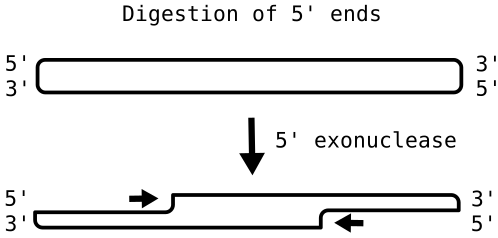
T5 Exonuclease (5' → 3' exonuclease activity):
- Chews back the 5' ends of the dsDNA fragments
- Creates complementary single-stranded 3' overhangs
- Activity is moderate - creates ~30 bp overhangs
Reaction 2: Annealing
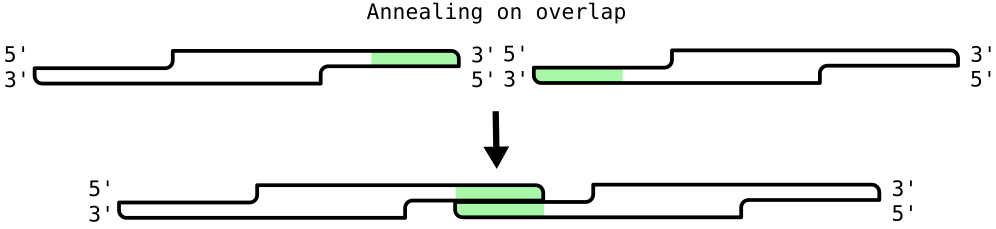
DNA to DNA interaction:
- The fragments anneal via their complementary overhangs, creating a seamless construct.
Reaction 3: Gap Filling

Phusion® DNA Polymerase (DNA polymerase activity):
- Fills in the gaps on the annealed single-stranded regions using the annealed strand as a template
- Works efficiently at 50°C
- Has 3' → 5' exonuclease activity (proofreading)
Reaction 4: Ligating
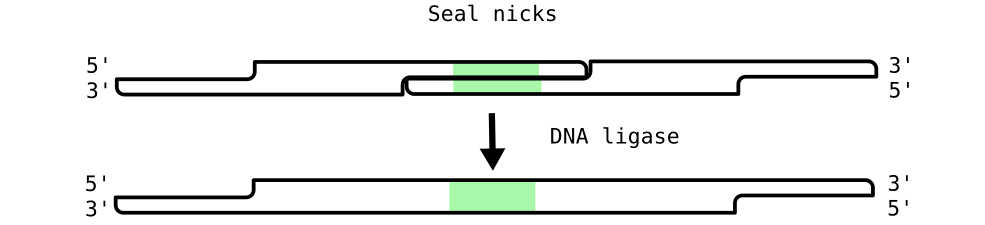
Taq DNA Ligase (ligase activity):
- Seals the nicks in the DNA backbone
- Creates phosphodiester bonds
- Active at 50°C (unlike T4 DNA ligase which prefers lower temps)
How It's Done in the Wetlab
The protocol depends on the concrete Master Mix. For example, you can find the protocol for the variants
among many other variants online.
⚠️ What to Care About
Protocols
- There are variations of the protocol depending on the company. This can change overhangs, incubation times, etc.
- Follow their protocol and hints.
Fragment Quality & Quantity:
- Use freshly purified DNA (stored at -20°C)
- Avoid over-digestion by exonuclease - don't exceed recommended DNA amounts
- Too much DNA (>1 pmol) → multiple fragment integration
- Too little DNA (<0.01 pmol) → low efficiency
Assembly Mix:
- Check if it is outdated.
- Store at -20°C, avoid repeated freeze-thaw cycles
- Verify master mix was properly thawed and mixed
Reaction Setup:
- Set up on ice
- Mix gently (pipetting or gentle vortex)
- Quick spin before incubation
Incubation Time:
- Ensure thermocycler really reached 50°C
- Don't under-incubate - give enzymes enough time
- Don't drastically over-incubate (>2 hours) - may cause exonuclease over-digestion
- 15-60 min is the sweet spot depending on fragment number
Complete Ligation:
- Some nicks may remain - that's OK: E. coli DNA repair machinery will fix remaining nicks after transformation
🔍 How to Check if This Step Failed
You can check if you find your problem in the troubleshooting guide for cloning from NEB. Common problems are:
Few/no colonies after transformation:
- Assembly failed (wrong overlaps, poor fragment quality)
- Incorrect molar ratios
- Master mix degraded or inactive
Many colonies but all wrong:
- Vector self-ligation (incomplete digestion or lack of dephosphorylation)
- Wrong fragments assembled
Literature
- Gibson, Daniel G., Lei Young, Ray-Yuan Chuang, J. Craig Venter, Clyde A. Hutchison III, and Hamilton O. Smith. "Enzymatic assembly of DNA molecules up to several hundred kilobases." Nature methods 6, no. 5 (2009): 343-345. https://www.nature.com/articles/nmeth.1318
- SnapGene Gibson Assembly Protocol at https://www.snapgene.com/guides/gibson-assembly
- SnapGene Video: Tips for Successful Gibson Assembly
License: © 2025 Matthias Függer and Thomas Nowak. Licensed under CC BY-NC-SA 4.0.